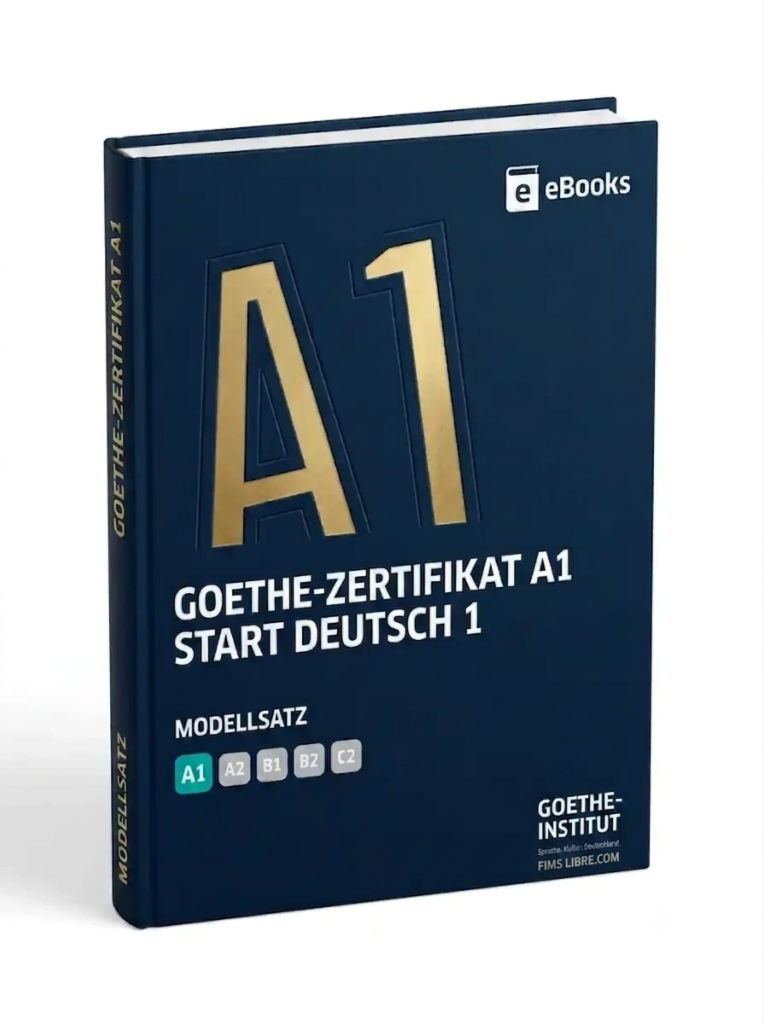
Struggling with Basic German? Let’s Talk About the Goethe-Zertifikat A1 Modellsatz Book.
So, I’ve been staring at this deep blue book cover with the massive golden “A1” stamped on it for the past few weeks. If you are anywhere near the world of learning German as a foreign language, you know exactly what this is—the official *Goethe-Zertifikat A1: Start Deutsch 1 Modellsatz* guide. Honestly, looking at it for the first time gives you a minor wave of anxiety, even though A1 is literally the absolute lowest beginner tier on the CEFR scale. I picked up this model exam packet to see if it actually prepares you for the test day panic or if it’s just a glorified, dry booklet that overcomplicates things for people who can barely say “Guten Tag” correctly yet.
To be fair, learning German feels a bit like trying to solve a puzzle while someone screams rules at you. The grammar is stiff, the words are long, and when you’re preparing for an official exam from the Goethe-Institut, the pressure changes the game entirely. This specific guide doesn’t try to hold your hand or teach you conversational slang. It has one very machine-like purpose: stripping away the mystery of the actual test format.
What exactly is a “Modellsatz” anyway?
If you’re confused by the title, it basically just translates to a “model paper” or sample test set. It mimics the exact structure, font, timing, and difficulty of the real-deal examination you take at the institute. The book is broken into the four mandatory pillars: *Hören* (Listening), *Lesen* (Reading), *Schreiben* (Writing), and *Sprechen* (Speaking).
I feel like the main idea here is psychological training. When you’re an absolute beginner, just understanding the instructions on a test paper can make you break into a sweat. By running through this specific packet, you get used to the weirdly specific layout the examiners love. It’s less about learning new vocabulary words and much more about learning how not to freeze up when the listening audio starts playing.
The Core Elements Under the Hood
It is a pretty slim volume overall, but it hits the target points without any fluff. Here’s a quick look at how the contents are laid out inside:
• Authentic Audio Scripts & Prompts: The listening section includes real-world speeds for A1, which frankly, still feels incredibly fast when you’re new. They give you the exact style of trick questions you’ll encounter.
• Writing Templates: The guide shows you exactly how to fill out those short forms and write the basic 30-word email/letter requests that can easily make or break your score.
• Speaking Cards Examples: It includes the visual prompt cards used during the oral group interview, showing you how to correctly formulate questions and commands on the spot.
What do you actually get out of this?
You learn how to navigate the traps. Goethe exams are famous for throwing in “distractors”—like an audio track where a speaker mentions three different times, but only one is the actual answer to the question. Working through this paper trains your ear to look for the specific turn of phrase that confirms the right answer. It shifts you away from translating line-by-line toward scanning for vital information, which is a massive milestone for a beginner.
Who is this meant for?
Obviously, this is strictly for individuals who need that official Start Deutsch 1 certificate for visa requirements, job validation, or academic benchmarks. If you are just casually learning German on an app on your phone for fun, don’t buy this book. It will bore you to tears. It is a highly dry, mechanical practice tool meant for formal test-takers who are actively finishing up an A1 course level.
My Honest Opinion: The Good and the Annoying
Let’s talk real talk about this book. On one hand, its utility is completely undeniable. Because it comes straight from the source, you aren’t guessing what the exam might look like; you are seeing the actual layout. The breakdown of the speaking section is incredibly helpful because it’s hard to visualize how that group interview runs without looking at the sample cue cards.
But man, it is a dry piece of material. It feels exactly like an institutional document. There are no colorful explanations, no encouraging side notes, and zero tips on *why* an answer is correct in the key sheet. It just gives you the solution and expects you to reverse-engineer the grammar rule yourself if you got it wrong. I don’t know why, but I feel like they could have easily added a short commentary section explaining the common mistakes students make on these specific questions.
Also, keep in mind it’s only *one* full model test set. Once you finish it, that’s pretty much it. You have to find other resources or online mock tests to keep practicing, making this feel like a very brief checkpoint rather than a comprehensive study companion.
📚 Related Books

💰 How to Add Ads in Your App & Start Earning Money
View Book →
Jolly Phonics Active book CVC Reading Passages – Short and Fun Stories for Early Readers
View Book →
Bildworterbuch Deutsch Die 2000 Wichtigsten Worter Satze Situationen im Alltag
View Book →
Grammar In Use Reference And Practice
View Book →
Practice Makes Perfect French Pronouns and Prepositions
View Book →Join Our Facebook Learning Groups
🇩🇪 Learn German Free 🇬🇧 English Learning Group 🇪🇸 Spanish Learning GroupJoin our educational Facebook communities to improve your language skills, practice daily conversations, and connect with learners from around the world.