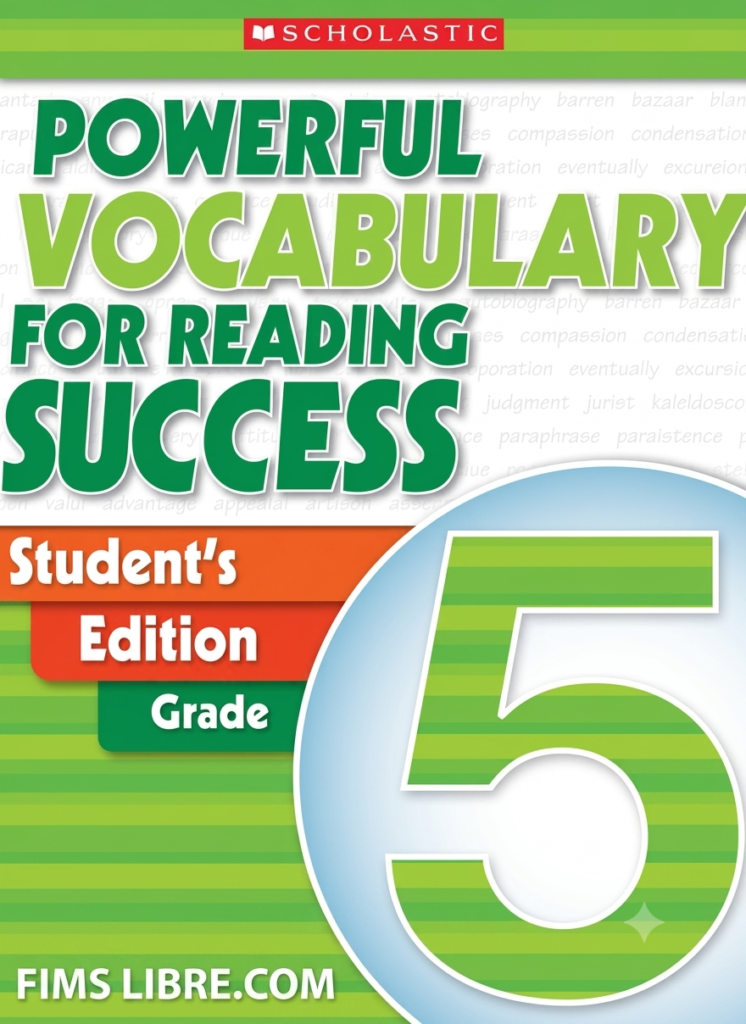
Honestly, finding language learning material for fifth graders that doesn’t feel completely insulting to their intelligence is a real chore. By the time kids hit age ten or eleven, they are trapped in this awkward middle zone where babyish picture books don’t work anymore, but dense middle-school textbooks just scare them off. So when I ran across Scholastic’s *Powerful Vocabulary for Reading Success* (specifically the Grade 5 Student’s Edition), I wanted to see if it actually handles this balance well. I’ve been flipping through the modules and watching how it presents contextual learning, and I figured it was worth breaking down my actual thoughts for parents or educators trying to sort through the noise.
📖 About This Book
Let’s talk about what this book looks like when you actually open it. It’s a structured Student’s Edition workbook from Scholastic, sitting right there under that huge lime green “5” on the cover. This isn’t a leisure reading book; it’s a direct, practical workbook aimed at improving reading comprehension through vocabulary acquisition. The version I looked at is available via Fims Libre, and it operates essentially as a lesson-by-lesson guide designed to expand a kid’s working word library. It has a very clear, traditional classroom workbook layout, packed with text passages, matching sections, and diagnostic fill-in-the-blank layouts.
🧠 Book Summary
The core concept behind this workbook is that kids shouldn’t just memorize long lists of definitions on flashcards. That method doesn’t stick. Instead, the book relies entirely on context-based learning frameworks. The main idea is to teach students how to figure out unfamiliar words by breaking down the sentences surrounding them, using prefixes and suffixes, and analyzing word roots. It focuses heavily on academic vocabulary—the kind of words that pop up constantly in standardized reading exams, science articles, and history lessons but don’t always show up in casual playground conversations.
⭐ Key Highlights
- Strong focus on word roots: It teaches children to look at Greek and Latin origins, which helps them crack open the meanings of words they’ve never seen before.
- Contextual reading snippets: Words are introduced through short paragraphs rather than dry columns of text, making retention much higher.
- To be fair, some of the fill-in-the-blank sentences feel a little old-school and rigid, but they get the job done when it comes to testing memory.
- Scaffolded lessons: The difficulty curve scales up pretty smoothly so the student doesn’t feel like they suddenly hit an unpassable wall.
🎯 What You Will Learn
If a student actually works through these units consistently, they are going to walk away with a much sharper toolkit for independent reading. They will learn how to identify structural context clues like definitions hidden inside sentences, synonyms, and contrast indicators. Instead of just guessing wildly or skipping over hard words when reading a novel, they will know how to decode words structurally using prefixes like *un-*, *dis-*, or suffixes like *—ment*. It basically teaches them how to think like a detective when facing complex texts.
👥 Who This Book Is For
Obviously, this is targeted right at fifth-grade students, but it’s wider than that. I feel like it is a fantastic fit for homeschool parents looking for an established, open-and-go vocabulary curriculum that doesn’t require a mountain of preparation time. It is also quite useful for remedial sixth graders who need a quick refresher because they keep stumbling over non-fiction reading material. But don’t buy this if you are looking for a casual storybook or something a kid can just browse passively—it requires an active pencil, a desk, and a decent chunk of focus to get real results.
💡 My Honest Opinion
Alright, let’s talk real perspective here. There is a lot to love about this Scholastic workbook, but it definitely has its moments where it drags.
What I genuinely think is great is the systematic approach to word structures. Teaching root words is the single best way to scale up a kid’s vocabulary fast, and this book handles that exceptionally well. The reading passages aren’t painfully long, which prevents kids with shorter attention spans from zoning out before they even get to the vocabulary questions. It feels like it was written by people who actually spend time in real classrooms.
But, I don’t know why, the design choices inside can feel incredibly dry after a few chapters. It is very standard, very black-and-white, text-heavy schoolwork. If you have a student who struggles with sit-down worksheets, this book isn’t going to magically charm them into loving vocabulary study. You will likely need to sit with them to keep the energy up. Also, sometimes the context clues provided in the questions are almost *too* obvious, allowing a clever student to guess the right answer mechanically without truly processing what the word means in the long run.
📥 Final Note
When you wrap it all up, *Powerful Vocabulary for Reading Success Grade 5* is a very reliable, old-school workbook that does precisely what it sets out to achieve. It won’t win any awards for thrilling entertainment, but if you need a straightforward, proven framework to build up a young reader’s comprehension before they head into middle school, this is an excellent tool to keep in your study routine. Just make sure to pair it with actual fiction reading so they can see these new words out in the wild.
📥 How to Download This Book
Click the button below to download this ebook in PDF format.
📚 Related Books
Join Our Facebook Learning Groups
🇩🇪 Learn German Free 🇬🇧 English Learning Group 🇪🇸 Spanish Learning GroupJoin our educational Facebook communities to improve your language skills, practice daily conversations, and connect with learners from around the world.