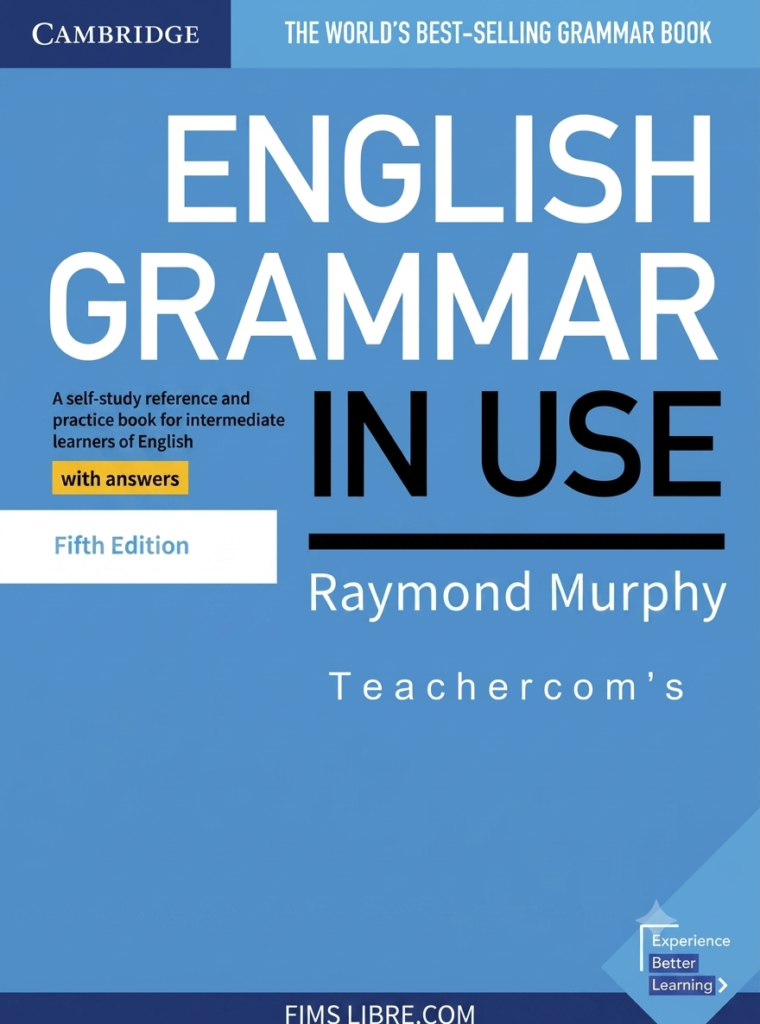
Let’s Real-Talk About Raymond Murphy’s “English Grammar in Use” Does the Ultimate Global Best-Seller Still Hold Up Today?
If you have spent even a fraction of your life trying to master or teach English, you have undoubtedly bumped into this classic blue book. Raymond Murphy’s English Grammar in Use is basically the undisputed heavyweight champion of the language learning world. The copy on my desk right now is the Fifth Edition from Cambridge, sporting that very distinct, clean blue cover with the little orange “with answers” tag. Honestly, when a book holds the title of “the world’s best-selling grammar book,” it carries an annoying amount of expectation. I wanted to sit down with this latest version to see if it’s genuinely the masterpiece people claim it is, or if we’re all just trapped in a massive loop of buying it out of pure academic habit.
To be fair, grammar manuals usually have the personality of a wet piece of cardboard. They overwhelm you with highly theoretical jargon that makes you want to pack your bags and give up entirely. Murphy’s whole angle has always been the complete opposite: radical simplicity. But let’s look at whether this fifth iteration actually refines that approach or if it’s just a subtle cosmetic update to keep making money.
What is this book actually trying to do?
The core setup of this book hasn’t fundamentally changed in decades, because frankly, it works. It is structured entirely as a self-study reference and practice workbook for intermediate learners. The genius—and I don’t use that word lightly—is in its layout format. Left-hand pages explain the grammar rules using basic, clear timelines and cartoonish examples, while the right-hand pages give you immediate exercises to see if you actually understood anything you just read.
The main philosophy here is intuitive pattern recognition. Murphy skips the deep, terrifying linguistic terminology. Instead of giving you a twenty-page lecture on the abstract concept of the present perfect continuous tense, he just shows you a picture of a guy standing in the rain and explains how we actually speak when we’re wet. It’s entirely practical, built for functional communication rather than passing a hardcore syntax exam.
The standout components of the Fifth Edition
While the classic structure remains intact, this version modernizes the experience in a couple of quiet ways:
- The 142-Unit System: Each unit is completely standalone. You don’t have to read this from page one to the end. You can literally just jump straight to Unit 36 because you’re confused about “used to” versus “would.”
- The Study Guide: Located right at the back of the book, this is a brilliant diagnostic test. It helps you identify exactly which structures are making you trip up so you don’t waste time practicing things you already know.
- Refined Examples: This edition quietly scrubs out archaic 1980s phrases and updates them with modern, natural expressions that people actually say on the street today.
What do you actually get out of working through it?
If you spend time with this book, you walk away with structural instinct. You stop calculating grammar formulas in your head before opening your mouth. Because the examples focus heavily on daily lifestyle situations, your brain starts treating English as a habit rather than an algebraic equation.
It builds a strange kind of peace of mind. Language learners often possess a massive vocabulary but feel entirely paralyzed when trying to connect those words accurately. This book bridges that specific gap. It turns raw vocabulary into coherent, confident speech patterns by gently ironing out all those minor, annoying mistakes you didn’t even realize you were making.
Who is this book actually designed for?
This book is the absolute gold standard for intermediate (B1/B2) students who want to study alone without a teacher constantly breathing down their neck. It’s also an indispensable lifeline for ESL teachers who need clean, simple ways to explain complicated things to their classes.
On the flip side, true beginners will find themselves completely drowning here. The explanations, though simple, require you to already understand basic sentence structures. Also, if you are looking to prep for advanced academic writing or a complex university thesis, this book is far too basic for your needs.
My Honest Opinion: The Triumphs and the Limits
Let’s talk about why everyone loves it, and where it kind of frustrates me.
🟢 Why it earns its crown:
The execution is genuinely beautiful. The two-page spread format means you never feel overwhelmed. You get a quick bite of theory, you do a quick drill, and you move on with your day. The clarity of the example sentences is unmatched; there’s zero fluff or unnecessary academic posturing. The answer key is straightforward and dependable, making it the ultimate tool for autonomous self-study.
🔴 Where it falls flat:
Honestly, it can get incredibly mechanical after a while. Filling out blank spaces on the right-hand pages can start to feel like robotic busywork. It doesn’t really push you to do any creative, open-ended writing or speaking, which means you can pass the exercises perfectly while still freezing up when someone forces you into a spontaneous conversational situation.
I don’t know why, but I also feel like the design, while clean, could use a bit more modern flair. It’s very safe. It looks precisely like the book your strict high school teacher would recommend, which might trigger some mild academic boredom if you don’t bring your own intrinsic motivation to the table.
Final Note
“At the end of the day, ‘English Grammar in Use’ is a global best-seller for a reason: it stripped the pretentiousness out of grammar learning. It’s an incredibly functional, reliable tool that delivers exactly what it promises on the cover. Just don’t use it in isolation. Pair it with real conversations, watch movies, read messy blogs, and use Murphy to quietly hold the structure together in the background.”
📚 Related Books
Join Our Facebook Learning Groups
🇩🇪 Learn German Free 🇬🇧 English Learning Group 🇪🇸 Spanish Learning GroupJoin our educational Facebook communities to improve your language skills, practice daily conversations, and connect with learners from around the world.